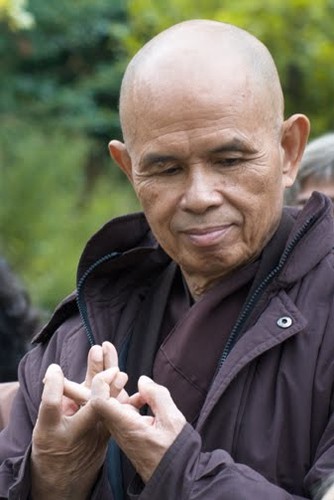
A Vietnamese Buddhist monk, teacher, poet, and peace activist, Thich Nhat Hanh drew on his monastic training to develop what he called engaged Buddhism — an approach that brought contemplative practice into direct contact with the practicalities of daily life and the concerns of the wider world. His writing and activism attracted attention across social and religious boundaries, and his work eventually brought him to France, where he established the community and practice infrastructure that would carry his teaching to readers and practitioners far beyond traditional Buddhist circles.
His book The Miracle of Mindfulness became a defining text: a practical guide using the most ordinary scenes — peeling an orange, washing dishes, answering a telephone — to show that awareness could be cultivated in any moment of common life. It framed contemplative practice as accessible to anyone, irrespective of background, and reached an audience well beyond established Buddhist communities. Alongside his writing, he founded the Order of Interbeing, a community of practitioners organised around his teachings on engaged Buddhism.
He established Plum Village in France — a global network of practice centres and monasteries — which grew into an ongoing home for retreats, Dharma teachings, and monastic life grounded in his tradition. The community has continued to host practitioners, publish his talks and writings, and train teachers in his method long after his most active years. His books, recorded teachings, and the continuing work of Plum Village are the living form of his legacy: an approach to mindful attention transmitted through both monastic and lay channels.
The Miracle of Mindfulness
The most accessible introduction to meditation ever written. 140 pages of pure clarity.