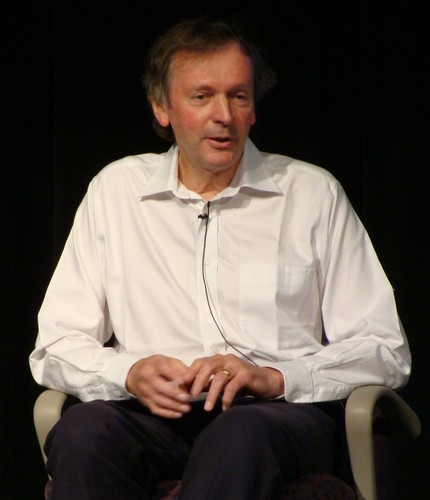
Rupert Sheldrake trained as a biologist at Cambridge, where he became a Fellow of Clare College and worked in developmental biology. His attention to the question of how living organisms take on and transmit their forms — how a species retains its own shape across generations — led him away from strictly mechanistic explanations and towards a hypothesis that biology's standard models could not contain. His doctoral training gave him the methodological grounding to pursue that question with rigour, even as his conclusions moved further from the field's consensus.
The hypothesis he developed, morphic resonance, proposes that nature retains a kind of memory: that organisms, societies, and even crystals are shaped not only by physical laws but by the accumulated habits of their kind, transmitted through non-material fields. He set out this position in A New Science of Life and extended it in The Presence of the Past. The work attracted sustained criticism from within mainstream science, but also a durable readership among those who found the standard materialist framework insufficient to account for what they observed.
Sheldrake has continued to develop and defend his ideas through books, public lectures, and a podcast co-hosted with philosopher Mark Vernon. His research has extended into animal behaviour, including documented parallels between humans and other animals in the experience of grief and bereavement. He runs ongoing masterclasses exploring both morphic resonance and the broader philosophical assumptions underlying contemporary science. His books remain in translation across multiple languages, and his website serves as the principal archive of his lectures, essays, and recorded conversations.
Rupert Sheldrake's Research
The morphic resonance hypothesis and other unconventional ideas about memory, fields, and nature.