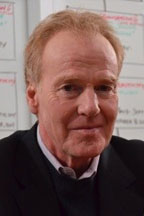
Peter Senge was born in 1947 in Stanford, California. He studied aerospace engineering at Stanford University before moving to the Massachusetts Institute of Technology, where he completed a doctorate at the Sloan School of Management. Working in the tradition of Jay Forrester's systems dynamics — a discipline concerned with feedback loops and long-run consequences in complex systems — he began developing a theory of how organisations either learn from experience or repeatedly undermine their own intentions without understanding why.
His 1990 book The Fifth Discipline identified five disciplines essential to building a learning organisation: personal mastery, mental models, shared vision, team learning, and systems thinking — the integrating fifth. Senge contended that most companies carried structural learning disabilities that no amount of effort or goodwill could overcome without first changing how people perceived the organisation itself. The book entered mainstream business education quickly and shifted how a generation of managers and executives thought about competitive advantage, culture, and the longer-term capacity of institutions to adapt.
A substantially revised edition appeared in 2006, drawing on fifteen years of implementation across organisations including BP, Unilever, Intel, Ford, HP, Saudi Aramco, Oxfam, and the World Bank, with new material on strategy, leadership, and what Senge termed systems citizenship. He has continued his work through the Society for Organizational Learning, a network he helped establish at MIT. The Fifth Discipline remains the primary reference for practitioners approaching organisational learning as a deliberate, structural discipline.
The Fifth Discipline
How organisations learn and why most of them don't. Systems thinking applied to human enterprise.