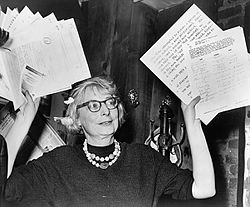
Jane Jacobs was born Jane Butzner on 4 May 1916. She built a career as a journalist and writer, with no formal training in urban planning and no college degree — qualifications that the planning establishment would later cite against her. Settling in Greenwich Village, New York, she grew increasingly attentive to the ways that top-down renewal schemes were eroding the social fabric of functioning neighbourhoods, and began developing a body of thinking about how cities actually sustain themselves.
Her 1961 book, The Death and Life of Great American Cities, made the case that urban renewal policy consistently failed ordinary city-dwellers, prioritising grand schemes over the street-level patterns that made neighbourhoods liveable. Drawing on close observation rather than planning doctrine, Jacobs introduced concepts — "eyes on the street," "social capital" — that gave new language to what residents already knew. Established figures in the male-dominated field dismissed her as a "housewife" and a "crazy dame"; the book outlasted the dismissals.
Jacobs also organised grassroots campaigns, most notably against Robert Moses's proposals for Greenwich Village and against the Lower Manhattan Expressway, which would have cut through SoHo and Little Italy; she was arrested at a public hearing on the project in 1968. That same year she relocated to Toronto, joining the resistance to the planned Spadina Expressway network. She died on 25 April 2006. The Death and Life of Great American Cities remains in continuous print and is a standard reference in urban planning and city design.
The Death and Life of Great American Cities
The book that saved cities from urban planners. Still the most important critique of top-down city design.