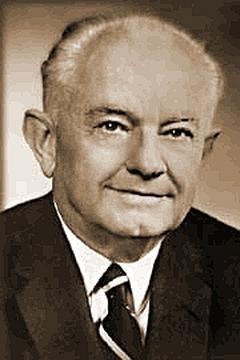
Ernest Shurtleff Holmes was born on 21 January 1887 on a small farm near Lincoln, Maine, the youngest of nine sons. His mother, a schoolteacher, read aloud from the King James Bible each evening, and philosophy and religion shaped the family's reading from the start. At fifteen he left for Boston; between 1908 and 1910 he enrolled at the Leland Powers School of Expression, where he encountered Mary Baker Eddy's Science and Health alongside the writings of Emerson, Ralph Waldo Trine, and Phineas Quimby. In 1912 he moved to Southern California, discovered the Metaphysical Library in Los Angeles, and extended his reading to Thomas Troward and other New Thought writers.
Holmes completed Creative Mind and Success in 1918 — published the following year — setting out the argument that the Universal Mind is the only mind there is, pressing itself around each person's thought and returning it transformed. He framed this not as doctrine but as a practical principle open to any individual. In 1927 he launched Science of Mind magazine, and in 1938 published The Science of Mind, the movement's systematic text. Together, these works established Religious Science as a coherent school within the broader New Thought tradition and gave it an institutional foundation that outlasted his own lifetime.
Holmes continued writing and teaching, publishing further titles including This Thing Called You in 1948. He died in 1960. Science of Mind magazine, which he founded in 1927, has remained in continuous publication, and his major books stay in print. The Religious Science movement he built carries on through organisations such as Centers for Spiritual Living. His central contention — that the creative power of a universal mind is accessible to each individual — remains the organising principle of that tradition.
Creative Mind and Success
The founder of Science of Mind on using mental law to create success — clear, practical, and spiritually grounded.