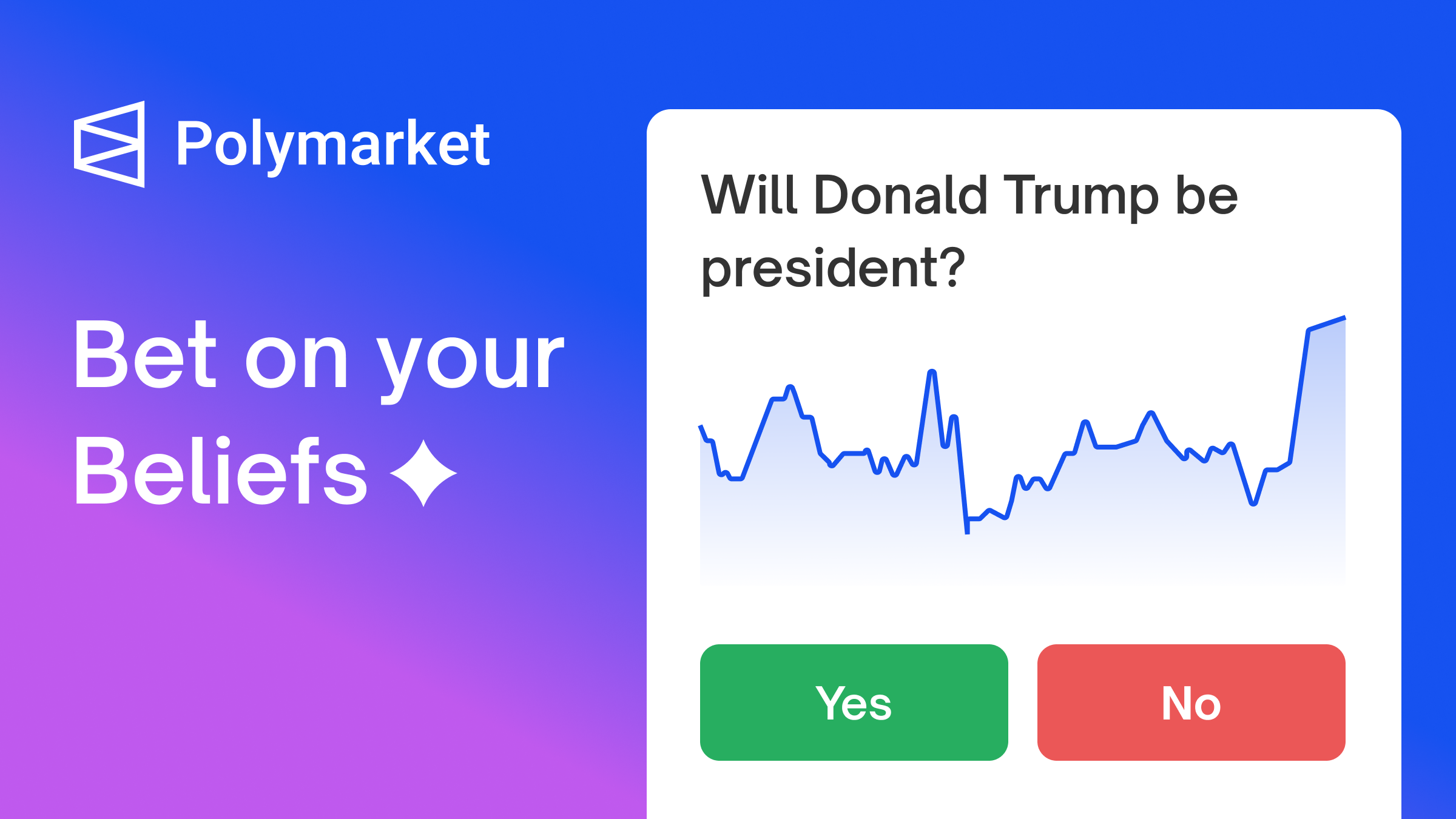
Markets that price the probability of a future event. Election outcomes, hurricane paths, sports results, geopolitics. Prediction markets aggregate dispersed information into a single auditable number.
Prediction markets are the most efficient information aggregator we have. The trouble is they're illegal.
Robin Hanson · Overcoming Bias, 2007
descend
Prediction markets are the oldest unfulfilled promise in crypto. Augur launched in 2018 with a fully decentralized REP-staked oracle and almost no users. Polymarket — Shayne Coplan's project, founded 2020 on Polygon — finally cracked it by being beautiful, USDC-denominated, and willing to be censored out of the U.S. while serving global volume. The 2024 U.S. presidential election put $3.6B through Polymarket and Nate Silver and Elon Musk both quoted its odds against the polls. The prediction market thesis stopped being theoretical that year.
The U.S. legal layer is its own story. Kalshi, founded by Tarek Mansour and Luana Lopes Lara in 2018, fought CFTC for years to list event contracts and finally won in 2024 with the Kalshi vs. CFTC ruling on election markets. That decision opened the U.S. market to regulated prediction trading and is the single most important regulatory win in crypto's adjacent neighborhood, even though Kalshi itself isn't on-chain. The DeFi mirrors — Drift Predict on Solana, Limitless on Base, Azuro across chains — are racing to build the on-chain equivalent.
The cultural argument Robin Hanson made in the 90s — that prediction markets are the most efficient information aggregators humans have built — is now being tested at scale. Polymarket's election volume out-predicted polling. The objection from regulators has always been gambling concerns; the objection from epistemics people is that they want it everywhere — pandemics, climate, science replication. The next cycle's question is whether on-chain prediction markets can offer enough liquidity to compete with Kalshi's regulated venue, and whether the U.S. lets them.
The crowd, priced.
The seminal text
The founding document.
Shall We Vote on Values, but Bet on Beliefs?
Robin Hanson · 2003
Democracies fail in part because voters are ignorant about most policy questions. Democracies could fail less if we let market speculators tell us which policies have what consequences. Specifically, when a clear policy metric — say GDP, or human flourishing — is chosen, betting markets can predict which proposed policies would best maximise that metric. Vote on values; bet on beliefs.
Robin Hanson's argument since the 1990s: prices in deep liquid markets aggregate information better than experts, polls, or pundits. Crypto finally made the rails work. UMA-resolved markets settled the 2024 U.S. election with sharper accuracy than legacy polling. Augur shipped the first attempt. Conditional tokens generalized the primitive. Kalshi cracked the regulatory ceiling. Futarchy proposed governance via prediction markets. Five pieces of how markets become epistemic infrastructure.
UMA-resolved markets
Polymarket
2020
Shayne Coplan's Polymarket (Polygon, 2020) became the dominant prediction market by 2024 — billions in 2024 election volume, attention-shaping accuracy on the Trump-Harris race, real liquidity on hundreds of binary outcomes. Settlement uses UMA's Optimistic Oracle: a proposer asserts the outcome, a dispute window opens, anyone can challenge with bonded UMA tokens, the DVM resolves disputes. The architecture matters: no off-chain admin, market-driven dispute resolution. CFTC settled with Polymarket in 2022 to restrict U.S. users; legal status remains contested into 2026.
Decentralized oracle / REP
Augur
2018
Joey Krug and Jack Peterson's Augur (Forecast Foundation) launched July 2018 as the first decentralized prediction market with native oracle resolution. REP (Reputation) holders staked on outcome resolution, with disputes escalating through fork conditions. The design was crypto-native and elegant; the UX was punishing. Volume never reached escape velocity. Augur V2 (2020) tried again with more streamlined mechanics. Mostly historical now, but the REP-staked dispute resolution model influenced UMA, Kleros, and most successor designs. The first attempt that proved the primitive could work.
Outcome tokenization
Conditional tokens (Gnosis CTF)
2020
Gnosis's Conditional Token Framework lets anyone construct outcome tokens for arbitrary conditions — outcome A pays 1 USDC if event X resolves true, outcome B pays 1 USDC otherwise, and minting both costs 1 USDC. Polymarket built on CTF in early years. The framework generalizes: combinatorial markets, scalar markets (price ranges), nested conditions. The primitive matters because it separates the market mechanism (LMSR, AMM, order book) from the outcome representation. Most modern prediction markets descend from this template.
Regulatory frontier
Kalshi vs CFTC
2024
Kalshi is a CFTC-registered Designated Contract Market shipping event futures since 2021. The 2024 ruling allowing Kalshi to list congressional control contracts — over CFTC objection that election markets violate public interest — opened the regulated U.S. prediction-market frontier for the first time. Kalshi isn't on-chain; it's a regulated derivatives exchange with prediction-market UX. Matters for crypto because it establishes the legal pathway prediction markets can travel domestically. Polymarket's offshore status looks more contingent against the Kalshi precedent.
Governance design
Futarchy
2000s (concept)
Robin Hanson's futarchy proposes governance by prediction market: vote on values (what we want to maximize), bet on beliefs (which policy maximizes it). Proposals pass when conditional markets predict they'll improve the metric more than the status quo. MetaDAO (Solana, 2024) shipped the first production futarchy implementation, running governance for several DAOs through conditional markets on token price. The conviction: deep markets beat token voting at deciding what works. Sample size is small, the design space is rich, the pattern is finally testable.
Working set
Projects we actually watch.
Conviction is stated as conviction; you decide what to do with it. Tiers below — Core,
Conviction, Watch, Speculative — reflect how much of FRQNCY's attention each project
currently earns, not a recommendation to buy.
29.04Polymarket called the U.S. presidential election before the NYT needle finished swinging. Three days later Shayne Coplan's Manhattan apartment was raided by the FBI. The platform stayed up. Nate Silver capitulated on Twitter that the markets read the country better than the polls did.the screenshot moment
AU
Augur
REP
watch
no websiteCrypto
AZ
Azuro
AZUR
watch
no websiteCrypto
DR
Drift
DRIFT
watch
no websiteCrypto
KA
Kalshi
watch
no websiteCrypto
LI
Limitless
watch
no websiteCrypto
MA
Manifold
watch
no websiteCrypto
MY
Myriad Markets
watch
no websiteCrypto
PO
Polymarket
watch
no websiteCrypto
A practice
Five small things, repeated.
Conviction is theatre without practice. Five steps that turn the thesis above into something
the body actually does, not just something the mind agrees with.
i
Trade a Polymarket position on a real event.
Pick a market with a clear resolution. Size small. Hold until resolution. Notice what your conviction actually is.
ii
Compare Polymarket to a polling aggregator.
Track an election or a Fed decision in both. The disagreements are the alpha.
iii
Provide liquidity to an Azuro pool.
On-chain LPing for prediction markets. Feel the impermanent loss when the favorite wins.
iv
Read Robin Hanson's Futarchy paper.
Vote on values, bet on beliefs. The governance application of prediction markets is the most underrated crypto idea.
v
Trade a science-replication market.
Pump.science or a Manifold replication question. The market is your peer review.
Two doors. Pick one.
The Crypto hub is the index of all sectors and the freedom-technology frame they share. The Fund is what happens when the same conviction gets put to work on behalf of the network.
Prices aggregate beliefs better than committees do.
Skin in the game is epistemics, not gambling.
Prediction markets are governance infrastructure waiting for permission.